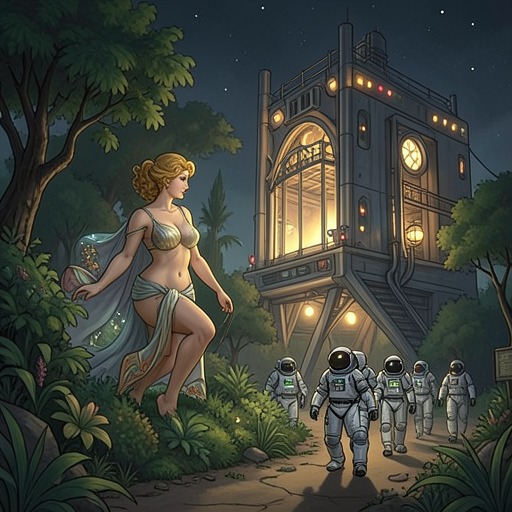
Native Venerians
Last and First MenNative Venerians are among the intelligent beings whose suffering complicates the beauty of the cosmos: they were imprisoned in their ocean and killed for human purposes. Their fate gives the narrator’s cosmic argument a concrete victim, making clear that a vision of universal fulfilment must reckon with lives that were denied it.
Identity and Fate
The passage places Native Venerians among intelligent beings, human and otherwise, who emerged into awareness, struggled, and lived amid pain and death. Their specific circumstances are starkly compressed: they were confined to their ocean and killed for humanity’s sake. The account offers no further description of their society or individual lives, but identifies them as more than scenery in the story of human advancement: they are among its harmed predecessors.
Place in the Cosmic Reckoning
The narrator sets their fate within a vast history of thwarted lives across many worlds. Native Venerians appear alongside the Martians and earlier human species as examples of suffering that cannot be cancelled by the beauty of the cosmos or by the happiness of a fortunate few. Their inclusion broadens the moral scope of the argument beyond humanity, even as the passage gives them no individual voice.
Narrative Significance
Their imprisonment and death sharpen the problem that motivates the rescue of the tragic past: a cosmic ideal would matter only if its eventual fulfilment could embrace every spirit across time, including those who never reached that vision in their own lives. Native Venerians therefore stand within the passage as victims of human action and as part of the wider claim that universal fulfilment must answer to suffering, not merely to beauty.